
Every child struggles with maths in a different way
A child may be able to calculate but stall on word problems, and the practice that helps depends on where they struggle. Petra Tutors looks at school materials and returned tests, and suggests a tutor and an approach to learning that suit your child.
Four clues that show where maths goes wrong
The same wrong answer can mean that number sense is vague or that the meaning of the sentence is hard to read, and what to check next differs. The table below gives examples for parents to observe; it is not a professional assessment.
The UK research charity Education Endowment Foundation (EEF) also explains that assessment in maths should not only record scores but use what a child understands, and where they are stuck, in the next stage of teaching.
| What you notice | What to look at at home | What to discuss in tutoring |
|---|---|---|
| Can say numbers but cannot grasp quantity | Can they split 14 into 10 and 4? | Check groups of numbers with objects and drawings |
| Digits slip during a calculation | Up to which step can they explain? | Review place value and the calculation steps |
| Cannot choose the equation for a word problem | Can they say what is being compared? | Sort out the wording and how the quantities relate |
| Gets confused when a shape is turned | Do they know it is the same shape when rotated? | Check the sides and angles that define it |
When calculation mistakes continue, look at the middle steps
If a child subtracting 19 from 47 takes away 10 from 47 and then 9 but loses track of the digits, do not assume they have not memorised it; ask them to leave their working on paper.
If exchanging a ten for ones is vague, check with groups of ten in a drawing or with blocks. You do not need to add large numbers of the same questions just because the calculation is slow.
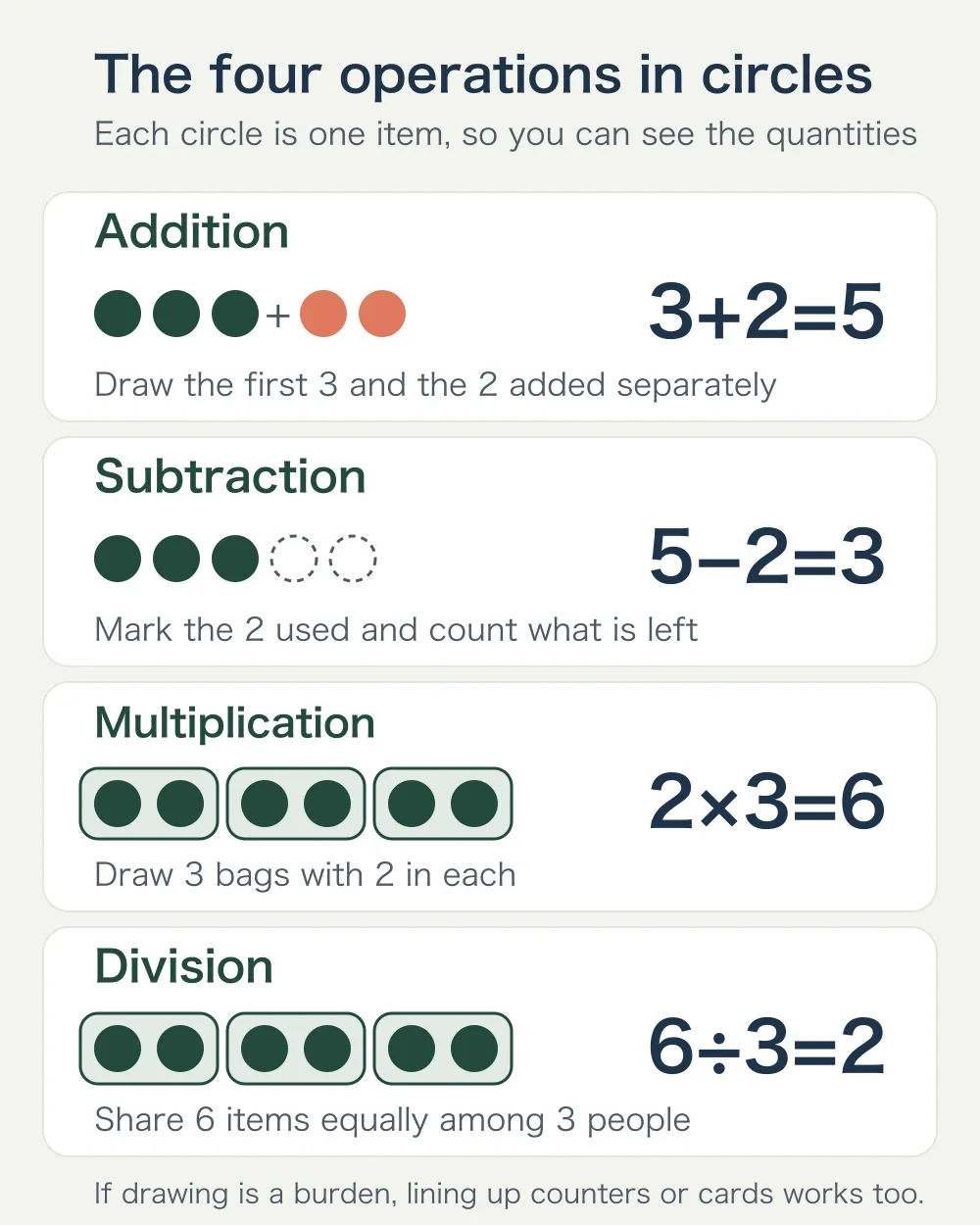
Some children remember their multiplication tables but cannot tell when to use multiplication. Drawing three groups of four and checking how addition and multiplication relate is one approach.
If word problems are hard, sort out the situation before the equation
If there are 15 red pencils and 9 blue pencils, how many more red pencils are there? The answer is 15 minus 9, which is 6, but a child may choose addition because they rely only on the word "more".
Ask in turn what is being compared, which numbers are known and what unit the answer has. Being able to read the sentence aloud does not always mean understanding the relationship between the quantities.
Rather than teaching the method first, check whether your child can explain the meaning of the problem in their own words or with a diagram.
For younger children, groups of numbers; for shapes, a change of view
A child may count from 1 to 20 but still be unsure about splitting 14 into 10 and 4. Lay out ten objects from around the house and add four, and numbers and actual quantities become easier to link.
If a triangle or a rectangle looks like a different shape when turned, cut out a paper shape, change its direction and talk about what stays the same. It is also a clue whether your child can describe features such as sides and angles, not only the name of the shape.
EEF's guidance for younger children describes ways of connecting understanding of numbers and shapes with concrete experience, using familiar objects and diagrams. It does not map British age bands directly onto Japanese school years.
Think with a diagram first, then move to the equation
For example, if there are three bags with four in each, drawing three groups of four dots shows how repeating the same number three times relates to multiplication.
When your child can solve a problem with a diagram, next simplify the diagram, and finally test whether they can explain with only the equation. Do not treat using diagrams as something to graduate from; adjust according to how your child is understanding.
At home, try a short review for just one week
Before keeping up long study sessions, you can try short activities of about ten minutes. Do not insist on the same time every day; put homework and tiredness first.
After marking, it matters not only to copy out the correct answer but to decide one thing to try next. On days that go badly, do not force it; simply noting it down as something to raise with the class teacher is enough.
- Monday: choose two questions your child got wrong from a school worksheet
- Tuesday: show one of them with objects or a diagram
- Wednesday: have your child solve a similar question alone
- Thursday: have them say where they got stuck last time
- Weekend: check whether they can use the way of thinking on an unfamiliar similar question
What to check when choosing a tutor
When it is hard for parents to explain alone, listing the difficult questions, the year group, the school's pace and the lesson format you prefer makes a consultation more specific. A good tutor does not only teach the method but checks where your child gets stuck.
Petra Tutors checks whether we have a tutor who can teach maths, whether lessons can follow the school's materials and whether the pace and manner of speaking look like a fit, before we make a suggestion. In the trial stage you can also check whether your child understands the explanation and finds it easy to ask questions.
At the first consultation it is enough to tell us one question your child got right and one they got wrong, with the days and lesson format you prefer. Tutors' subjects and availability change, so we cannot guarantee that your wishes will be met.
Summary
If you feel your child is struggling with maths, before hurrying them through calculation, try looking separately at groups of numbers, the middle steps, the meaning of word problems and understanding of shapes. Parents do not need to judge the cause alone.
If reviewing at home is hard, you can consider one-to-one tutoring that suits your child, in consultation with their school. In your consultation with Petra Tutors, we work out how to proceed together from the school materials, the format you prefer and the problems your child has now.
References
- EEF (UK research charity): guidance for maths from the middle of primary school
- EEF (UK research charity): guidance for early-years maths
- EEF (UK research charity): deepening understanding with objects and diagrams
- EEF (UK research charity): reflecting on learning and specific advice
- Suginami City: education counselling guidance
- Petra Tutors: maths tutoring
- Petra Tutors: free trial and consultation