
Four checks to try first
There is not always a single way of getting stuck. If the audio is hard to hear, check the device and any background noise before rethinking what is being studied.
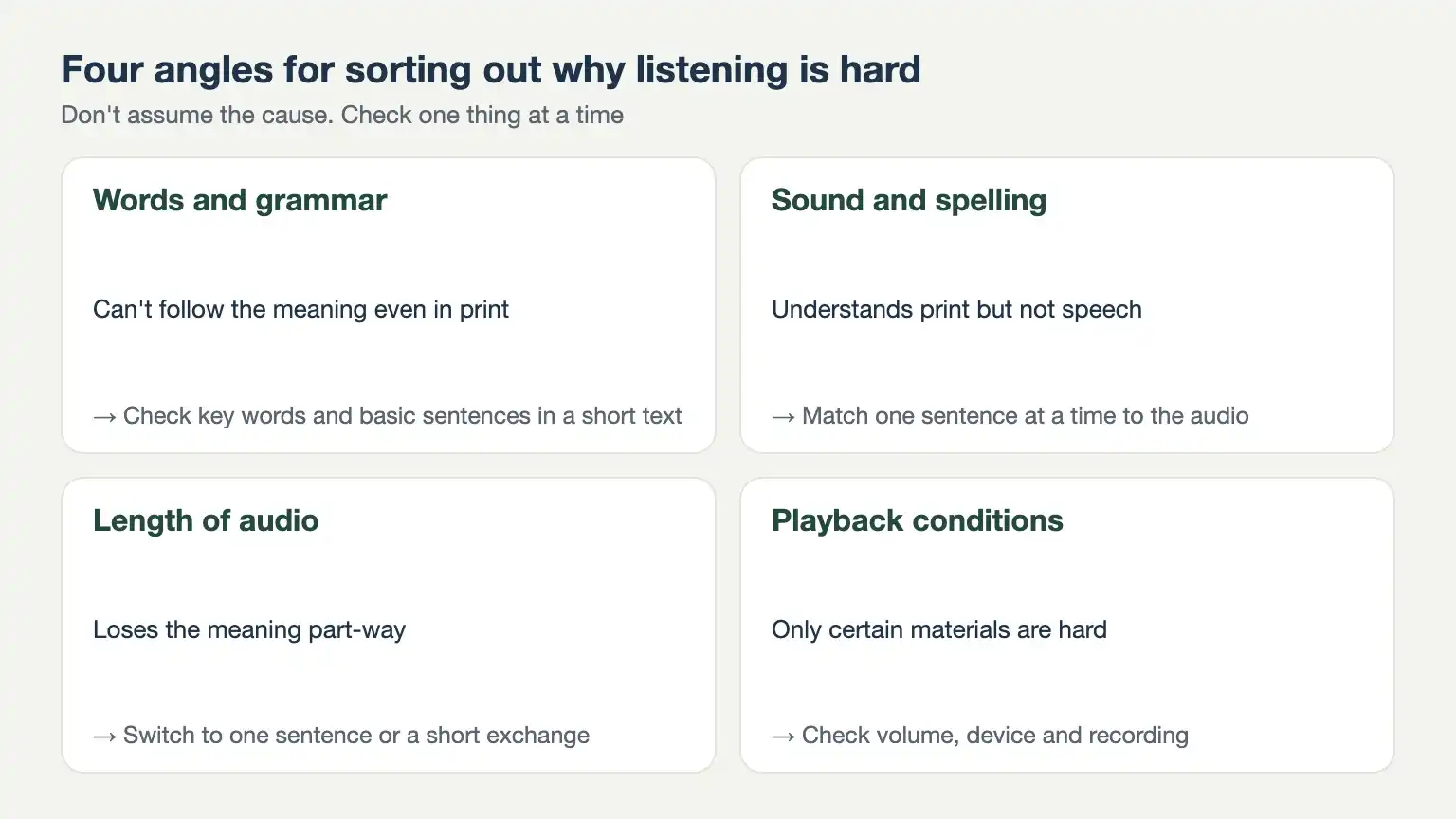
The table sets out, for each way of getting stuck, a possible factor and what to try first. Even if a row fits, you don't need to settle on a cause. Compare whether your child understands it when reading, and whether they follow it when the audio is shorter, and use that to choose the first practice.
| How they get stuck | Possible factor | What to try first |
|---|---|---|
| Can't follow the meaning even in print | Understanding of words or grammar | Check key words and basic sentences in a short text |
| Understands print but not by ear | Link between sound and letters | Match one sentence at a time to the audio |
| Loses the meaning part-way | Length of the audio, or the load it puts on them | Switch to one sentence or a short exchange |
| Only certain materials are hard to hear | Volume, device or recording conditions | Check the playback setup and the material |
When they understand it in print but not by ear
For a sentence your child understands when they see it, start by listening to just that one sentence and then read it to check. Once the audio and the word order connect, listen to the same sentence again and it is easier to see which word was missed.
Even words your child knows can sound different. In spoken English, words run into each other or are pronounced weakly. Don't judge the sound from the spelling alone; check the actual sound in a short sentence whose meaning they understand.
If your child cannot get the meaning even when reading the text, listening practice alone will be too much. You could go back to words and basic sentences learned at school and increase the number of sentences they understand.
A four-step practice that starts from one sentence
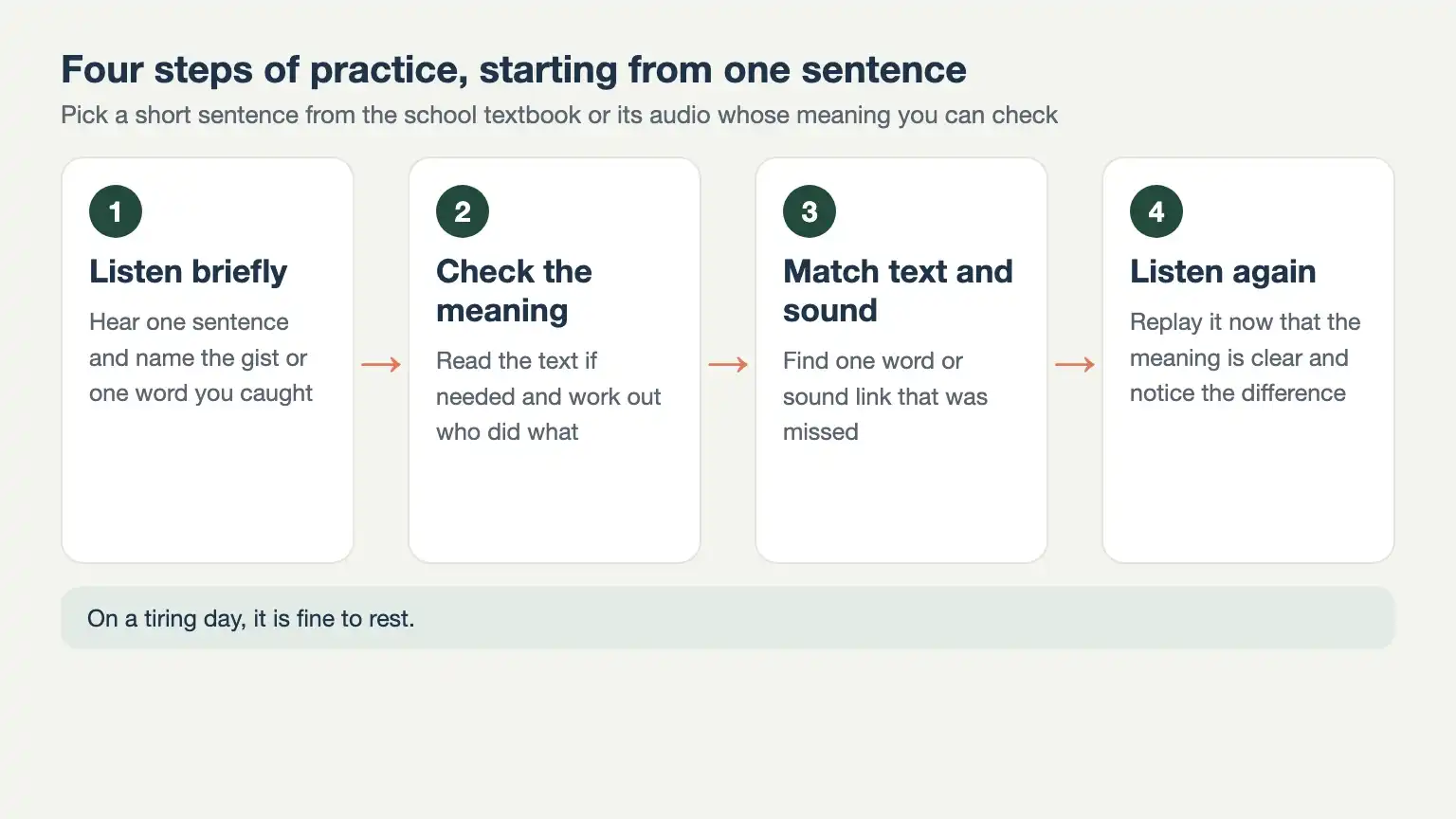
Your child does not need to listen to a long conversation at once. From the school textbook or its audio, choose one short sentence whose meaning they can check.
- Listen briefly: first hear just one sentence and name the gist or one word they caught.
- Check the meaning: read the text if needed and work out who did what.
- Match sound and text: find one word or sound link that was missed.
- Listen again: replay it now that the meaning is clear and notice how it differs from the first time.
Shorter before slower, and dictation and shadowing are optional
Material that lets you slow down playback can help with first understanding. If it is still hard, making the sentence shorter or going back to audio with more words they know may suit better than slowing it further.
School tests may specify normal playback conditions. Think of practice for understanding and practice answering under conditions close to the real thing as separate purposes.
Even if they cannot write down the whole sentence, your child can name one word they heard or pick the picture that matches. If writing takes time, check listening and writing skills separately.
Shadowing, repeating after the audio as you go, is also not necessary for every child. Rather than repeating audio they don't understand, it matters to start from short expressions they do.
A week of practice with textbook audio
Before you add new material, building around the school textbook, workbook and accompanying audio makes it easier to link practice to that week's lessons. This is an example you can adjust, not fixed homework.
- Monday: read a short sentence and check any unfamiliar words or basic sentence patterns.
- Tuesday: listen to the audio of the same sentence and find one difference between letters and sound.
- Thursday: listen to another short piece of audio that uses the same words.
- Weekend: listen again to the sentence that was hard at the start and see what has changed.
Adding materials, before school tests and what to say at home
On a tired day, it is fine to rest. Rather than how long they practised, note whether they understood a sentence they previously could not; that makes it easier to see what to work on next.
If the textbook audio is too hard, the British Council's beginner listening material for teens is another option. Choose material with short audio and comprehension questions that suits your child's level.
In research terms, reviewing material after a gap has evidence behind it as a support for learning. That alone, however, has not been shown to raise Japanese junior high students' English listening scores within a particular period.
When a test is close, check the range sheet, the textbook, and the length of the audio and the question format. After they understand the vocabulary and content, adding practice under conditions close to the real test lets you separate everyday understanding from test practice.
Rather than counting only the questions they could not follow, noting one word they heard, one sentence whose meaning they got and one sound to check next makes it easier to choose practice. The UK EEF's research on oral language activities and on specific feedback is also a reference for thinking concretely about the next step.
If your child keeps looking distressed, don't simply add more study; you can talk to the class teacher about how hard the material is and about ways of supporting them. The volume of materials and devices also affects how easy it is to take part.
Petra's school English support
Petra Tutors offers learning support that uses the school textbook, workbook and the range of regular tests to sort out which part of English your child finds hard. Where listening is hard, rather than repeating the audio alone, we can go back to the vocabulary and basic sentences needed.
The actual teaching and tutor are discussed after we check your child's situation. For review using the textbook, you can see how it works in practice on Petra Tutors' English learning support.
Summary: work out together where they lose the thread
Why a child cannot follow English by ear cannot be judged from the amount of practice alone. Checking whether they understand it in print and whether they hear it when the audio is shorter makes it easier to decide what to try next.
If they keep stumbling on school material, you can sort out what they are studying and where they struggle, then talk to a school teacher or a tutor. If you would like to sort out where your child struggles with the school textbook and audio, you can use Petra Tutors' free trial and learning consultation. We check goals and materials, then think together about a way of learning that suits them.
References
- MEXT Junior High School Course of Study (2017) commentary, foreign languages (Japanese)
- British Council LearnEnglish Teens, beginner listening
- US Institute of Education Sciences, practice guide on spacing out review of learned material
- UK Education Endowment Foundation, Oral language interventions
- UK Education Endowment Foundation, Feedback