

Separate scores from your child's worth
A low score and your child's worth or potential are separate things. Rather than judging how they are doing by scores alone, think about the next step to suit how they seem.
The table sorts next steps you can try by how your child seems. If a row fits, you still don't need to decide the cause.
| How things look now | A next step to try |
|---|---|
| Wants to avoid talking about study | Don't force a goal; wait until they are ready to talk |
| Stops at hard questions | Go through one question your child chose, using a diagram or a short example |
| Keeping records is itself a burden | Don't ask for daily records; change the method |
Three things to check before setting a study goal
If it is hard to choose materials and goals at home alone, you can see what you can ask about in Petra Tutors' personal study support. Before you decide on a study goal, check these three things.
Don't put a big goal in place too quickly
A goal such as beating the class average on the next test, or passing an Eiken grade, can be motivating. But when confidence is low, missing a goal can add to the burden.
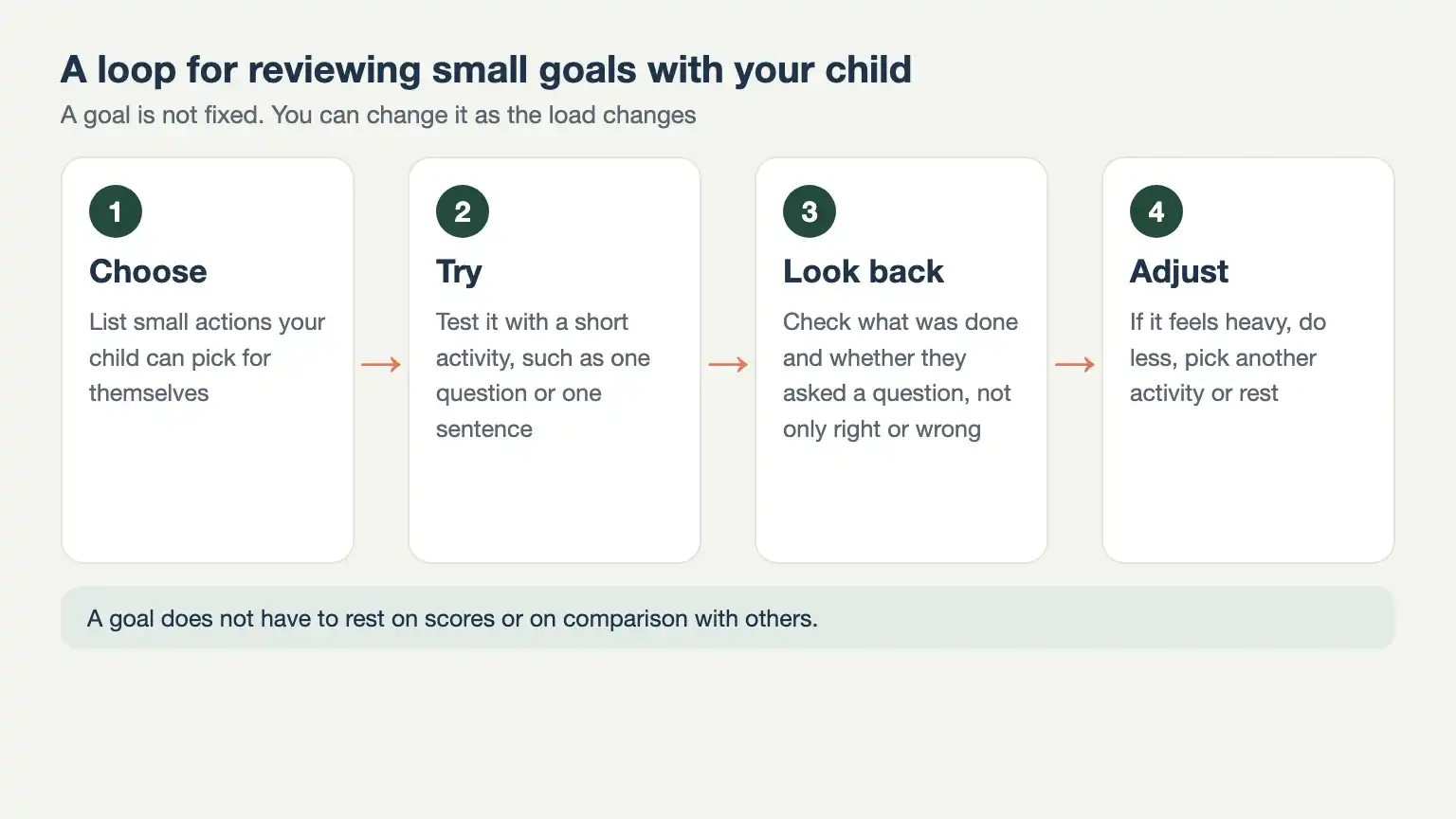
Start by listing small actions your child can choose, such as understanding one example question or asking one question about something they don't follow. Rather than setting deadlines and amounts for them, talk it through to suit how they are now.
The Japanese MEXT courses of study page (in Japanese, revised 2017-2019) lets you check the standards for each school stage. MEXT's page on individually optimised and collaborative learning (in Japanese) sets out the idea of adapting teaching to each child's understanding and circumstances.
The UK Education Endowment Foundation's metacognition and self-regulated learning research covers planning how to learn, checking along the way, and looking back to adjust.
At home, one approach is to aim not only for a score but for your child being able to explain the conditions of a problem in their own words. You don't need to set the same deadline or level of difficulty for everyone. EEF research mainly concerns learning outcomes in schools, and does not guarantee that an individual child's confidence will recover.
Match the difficulty of materials and the wording of goals to your child
If problems at their current year are hard, it is fine to go back to an earlier unit they need to understand. A junior high student reviewing fractions, or rereading basic English sentences, is preparing for what comes next. Some children find it hard to engage if the material feels childish, though. Separate how hard the content is from how the material looks, and look together for material that suits their age and interests.
A goal such as I want to be able to explain adding fractions with a diagram makes it easier to choose the next action than a big goal such as work hard at maths. If your child finds it hard to put into words, you can offer several options, such as going through one question together, reading an English sentence on a topic they like, or taking today off. Don't insist on daily achievement; value keeping a state in which they can talk to you.
What went well, off days and records
Beyond words of encouragement, tell your child specifically what they actually did, such as writing out working or finding the main point of a passage. Questions they could not answer are also clues for changing how you explain next time.
Don't decide on an adult's judgement alone; check whether your child feels they understand more than before. Even on days when the number of correct answers does not grow, you can notice that they organised their thinking or asked a question.
On a day when things don't go as planned, don't put it down only to motivation or character. Look back at how hard the questions were, what time of day it was and how it was explained. You can cut it to one question, choose other material or rest. Finding a way of learning your child can manage matters more than sticking to the original plan.
Comparing scores with classmates or siblings doesn't show what your child needs to do next. Strengths and living circumstances differ, so they don't need to learn at the same speed either. Check, in line with their wishes, whether they can explain more than before or ask questions more easily. If they dislike being compared, consider talking about study less.
Recording hours studied or the number of questions can help. But when confidence is low, the unfinished items can be all that stands out and add to the burden. If you do keep a record, a line each on what they understood, where they needed help and what they want to try next is enough. If your child does not want to keep one, an adult can use it as a note for adjusting how they explain.
The UK EEF's feedback research shows the importance of telling a learner specifically what they did well and what to try next, rather than judging their character or talent. Its research on parental engagement is also a useful reference for thinking about how home and school work together, but it does not mean parents should manage all of their child's learning.
A record can be used not to compare results with other people but to talk about the next way to learn when your child wants to. If it adds to the load, change how you keep it.
Petra Tutors' personal study support
Not only a test score but also getting through a small task your child chose can be a clue to how they are learning. Petra Tutors offers consultations on one-to-one study matched to your child's understanding and load.
We cannot guarantee a return of confidence or better grades. You can ask about it through a free trial and learning consultation.
The role of teachers and tutors
When you talk to a school teacher or a tutor, look together for where understanding stops and ask whether they can change how they explain. In a trial lesson too, how easy it is to ask questions matters as much as the number of correct answers.
Having someone outside the family to talk to about learning is one option, but it does not by itself guarantee a return of confidence or better grades. Consider it while checking your child's wishes.
What to say as a parent, and facing worries about the future
Encouragement such as you can do more than this can feel like pressure. Instead, ask where it was hard and whether they would like to try another way, in a form that they can decline. If your child does not want to talk, you can leave the conversation for later. Don't fill all your time together with study; leave time to enjoy something they are interested in.
Telling your child in a hurry that they can't get into a school because their grades fell may leave them unsure what to do next. Application and entry conditions differ by school and region. One approach is for you to sort out the information first and share it to the extent your child can think about it.
When a deadline is close, talk to the school's careers teacher, so that your child alone does not carry the burden of the decision.
When it feels heavy, review the goal
A study goal for a child who has lost confidence does not have to be decided by scores or by comparison with others. You can start from small actions your child chooses and review them if the load grows.
Instead of a big goal of raising a score, you can use actions your child chooses as markers, such as explaining one question with a fraction diagram, or reading one favourite English sentence and checking its meaning. Afterwards, look back, as far as your child wants, not only at right and wrong but at asking a question or understanding more than before. Don't make comparison with others or daily achievement a condition.
On a day when a goal feels heavy, you can review it by doing less, choosing another activity or resting. You don't need to tie the reason for missing it only to character or motivation. If your child does not want to talk about study, it is fine not to push for a record.
Decide what to share with the school or a tutor with care for whether it is needed, your child's wishes and their privacy. If strong physical or emotional difficulties continue, don't try to deal with them only through materials or scores; consider an appropriate specialist service.
Summary
When confidence is low, start the study goal from small actions your child chooses. Review it if the load grows, and, dividing roles with the school and supporters, look little by little for a way of learning in which they feel safe to ask questions.
References
- MEXT Courses of Study revised 2017-2019 (text and commentary index, Japanese)
- MEXT Individually optimised and collaborative learning (support that suits each learner, Japanese)
- UK Education Endowment Foundation, Feedback (specific advice)
- UK Education Endowment Foundation, Metacognition and self-regulation (planning and reflection)
- UK Education Endowment Foundation, Parental engagement (home and school working together)