
Check what the text means before you draw
First, break the problem into short pieces and check together who has what and what is being asked. If a child picks out only the numbers, they can mix up different kinds of quantity, such as people and items.
In a problem about giving 2 apples each to 3 people, for example, separate the 2 apples per person from the 3 people. Drawing 3 groups of 2 makes the meaning of 2 × 3 easier to think about.
If reading the text is a burden, an adult can read it aloud or show it in shorter sentences. That way you can treat difficulty with reading separately from understanding the quantities.
The Japanese MEXT courses of study (in Japanese, revised 2017-2019) set out primary arithmetic learning that uses objects, diagrams and expressions to think about how quantities relate and what a problem means.
The UK Education Endowment Foundation's guidance Improving Mathematics in Key Stages 2 and 3 covers maths teaching from the upper primary years into lower secondary. It describes linking diagrams and objects to numbers and expressions.
However, UK year groups and materials are not the same as those in Japanese primary schools. Nor does the guidance promise that drawing a diagram will solve every problem.
Start by sorting out the quantities the text gives, the quantity you need to find and the units. Next, show it with pictures or lines. Finally, check that the diagram, the sum and the answer all describe the same thing.
Thinking about the four operations from familiar pictures
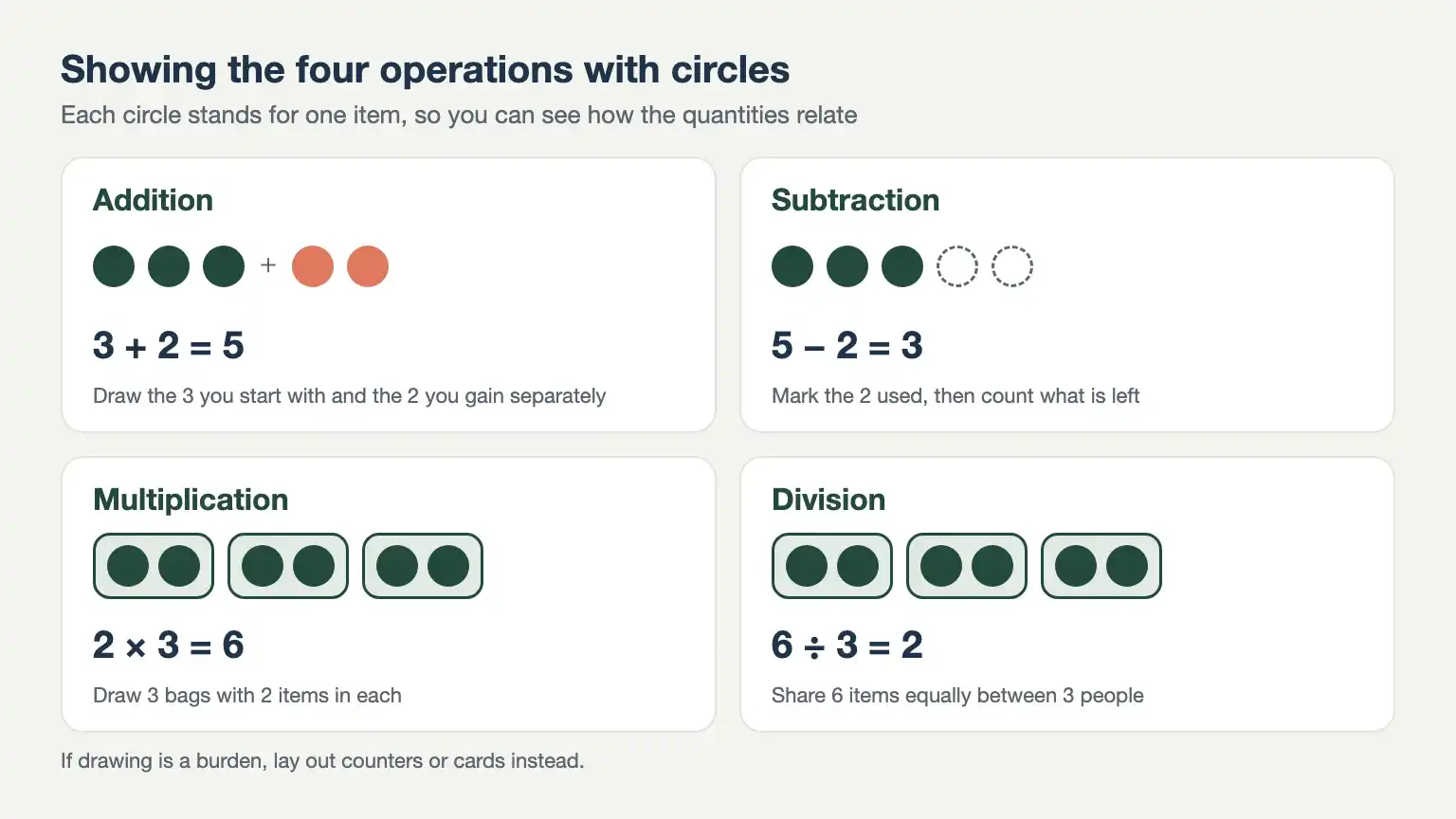
At first, simply drawing apples or counters as circles is enough. When you draw the number added, the number used and groups of the same size, you can think about what each number in the sum stands for.
To add 2 to 3, for example, draw the circles as 3 and 2 separately. If drawing is a burden, you can lay out counters or cards and check with them.
The table shows how each kind of calculation can be pictured. Your child can choose the way that feels easiest to handle.
| Way of thinking | Example of a diagram |
|---|---|
| Addition | Draw 3 and 2 separately, then look at the total |
| Subtraction | Draw 5 and mark the 2 that were used |
| Multiplication | Draw 3 bags with 2 items in each |
| Division | Share 6 items equally between 3 people and count one person's share |
Checking each operation with a diagram
For addition, if your child has 3 apples and is given 2 more, draw the first 3 and the extra 2 apart. After checking that there are 5 altogether, match it to 3 + 2 = 5. A word such as given does not by itself mean add, so what matters is seeing what changed and how many.
For subtraction, if 2 of 5 were used, first draw 5 circles and mark the 2 used. Once your child sees that 3 are left, they can check what 5 − 2 = 3 means. If they are unsure which number to subtract from, go back and check the number there at the start.
For multiplication, if there are 3 bags with 2 sweets in each, draw 3 groups of 2. Being able to recite the times tables is a different skill from choosing multiplication in a word problem. Saying in words what the 2 and the 3 in the diagram refer to helps your child understand 2 × 3 = 6.
For division, if 6 sweets are shared equally between 3 people, draw 6 circles and split them into 3 groups. Each person gets 2, which matches 6 ÷ 3 = 2. Sharing equally and giving out 2 at a time to find how many people can be served ask different questions. Use the diagram or real objects to check whether the answer is a number of people or a number of items.
Bar models, ratios and units
As children move up the years, they may use a bar model, in which the length of a line shows how numbers relate. If drawing one is itself hard, it is fine to show the situation with circles or cards first.
If there are 10 items in all and 4 are used, for example, show 4 and the rest inside a line that stands for 10. Tidy up the form once your child understands what the line represents.
In problems about ratios and fractions, what you compare against matters. Half of 10, for example, can be shown by splitting a line for all 10 into two and marking 5. You can start from familiar relationships such as half or double, and link numbers and sums afterwards.
Write units such as items, yen or centimetres next to the numbers in a diagram, not the numbers alone. 3 people and 3 items are the same number with different meanings. Tell apart the number each person gets, the number of people and the total, and finally check that the unit of the answer matches the question.
From Petra Tutors, on learning word problems
If drawing a diagram still does not make the quantities clear, you can go back to pictures and objects. At Petra Tutors you can talk to us about practice that suits your child, separating reading the text from understanding the calculation.
Using diagrams is not the aim in itself. Understanding what the quantities mean is.
See maths tutoring and meet our tutors for what we offer. In the free trial and consultation, tell us about your current materials and the word problems your child finds hard.
When a diagram does not suit, change the method
Sometimes drawing takes so long that it makes things harder to follow. In that case you can switch to counters, a number line, a table or explaining in words.
Not every child needs to use the same kind of diagram. Looking at what your child understands and where they get stuck, then changing the method, is one more way to support learning.
The US Institute of Education Sciences 2021 practice guide for the elementary years, Assisting Students Struggling with Mathematics, covers step-by-step support for children who struggle with maths. It describes combining objects, diagrams, number lines, mathematical language and instruction on word problems.
The UK EEF's research on feedback shows the importance of telling a learner specifically what to think about next, based on what they understand. Its guidance on metacognition and self-regulated learning covers thinking about a method before solving, checking along the way and reflecting at the end.
Education research from the US or UK cannot be taken as a guarantee that any individual child in Japan will score higher. Move between diagrams, sums, objects and words and look for the way of showing things that your child finds easiest to follow. Here are three things to check in a word problem.
Practice and encouragement that are easy to keep up at home
Rather than working through many word problems in a day, you can set aside time to check, for one problem, that the diagram and the sum show the same thing. If your child gets it wrong, ask how far they understood and go back to the text or a picture. Once it makes sense, try a short problem with only the numbers changed.
Look at whether your child could explain what the numbers mean, not only at how many were right. For example, on the first day read one short word problem, and on another day show it with pictures or cards. If there is time, try one more problem with the same idea and talk about which explanation helped. You do not need to do this every day.
When no sum comes to mind, you can ask slowly what the situation is and what it would look like as a picture. There is no need to rush the calculation. If it is hard to put into words, pointing or using cards is fine.
If studying together turns into arguments, you could ask a teacher or learning supporter. If it is hard to judge at home alone, you can also look at what you can ask about in Petra Tutors' maths tutoring.
If your child can calculate but finds it hard to build a sum from the text, it helps to tell the school an example of the problem they got stuck on and how far they understood. You can also share which pictures or explanations were clear. If reading or writing is a burden, mention that separately and think together about support.
Struggling with word problems does not mean you need to decide on a developmental or learning label at home. Pictures, bar models and tables each suit different situations. Rather than sticking to the method an adult is used to, choose together the way of showing things that helps your child explain the quantities.
Summary
The purpose of using diagrams in word problems is to make the relationship between quantities clearer. You can read the text, think with pictures or objects and, as needed, move on to bar models or tables.
If drawing is hard, it is fine to go back to words or cards. Use your child's ability to explain, linking diagram and sum, as a guide, and practise from one problem that feels manageable.
References
- MEXT Courses of Study revised 2017-2019, primary arithmetic (Japanese)
- US Institute of Education Sciences, Assisting Students Struggling with Mathematics (2021)
- UK Education Endowment Foundation, Improving Mathematics in Key Stages 2 and 3 (2017)
- UK Education Endowment Foundation, Teacher Feedback to Improve Pupil Learning (2021)
- UK Education Endowment Foundation, Metacognition and Self-Regulated Learning (revised 2025)