
Start with where she is stuck, not the score
EIKEN Pre-2 draws on content roughly equivalent to the middle of Japanese high school, so it is a genuine stretch for an elementary school student. That is exactly why the first move should not be sheer effort or hours, but figuring out precisely where your child stops.
Is it vocabulary? Shaky grammar? Not enough stamina to get through a long passage? No template for writing an opinion? The answer changes what you should actually work on.
At Petra Tutors, we generally do not recommend starting elementary Pre-2 preparation by grinding past papers alone. Past papers matter, but repeating them on a shaky foundation does not raise the score: it mostly teaches a child that they “can’t do it.”
Identifying which of reading, listening, writing and speaking has the gap, then building the right order of study around it, is the more direct route to passing.
What you notice, and where to start
Match what you see in past papers or at the desk to a likely cause and a first exercise. If several apply, start with the one furthest upstream (vocabulary in context, reading sentences); the later ones often ease on their own.
| What you notice | Likely cause | First exercise |
|---|---|---|
| Memorised the word list but misses vocabulary-in-context questions | Knows meanings, but not how the words behave inside sentences | Say each word in a short example sentence aloud; reread the whole sentence around any missed blank |
| Loses the thread in the second half of a passage | Following the flow, rather than reading speed, is the gap | After each short paragraph, say who did what and why, in Japanese |
| Follows the listening conversations but picks the wrong option | Reads the options slowly or does not preview them | Read the options before the audio and predict what to listen for |
| The e-mail reply leaves questions unanswered | No habit of counting the questions in the e-mail | Mark each question, list the answers in Japanese, then put them into English |
| Freezes on the opinion essay | Has not decided a view and two reasons, even in Japanese | Say the opinion and two reasons in Japanese, then shorten them into English |
| Goes silent in the interview | Not used to responding quickly, whatever the English level | Practise a one-phrase reply within two seconds; do not aim for perfect sentences |
Three places elementary students get stuck on Pre-2
1.Knowing what a word means, but not being able to use it in a sentence
The first thing worth re-examining is how vocabulary is being learned. Words like environment and experience (a step more abstract than Grade 3 vocabulary) do need to be learned. But many children who have only memorised the Japanese translation cannot actually extract the meaning once the word appears inside a real sentence.
A child might know important perfectly well, then freeze the moment it appears in It is important to sleep well before a test, unable to piece the sentence together.
This is not a lack of effort. Knowing a word in isolation and understanding it inside a sentence are genuinely different skills, and Pre-2 is where that gap starts to show up clearly in the score.
2.Losing concentration partway through a long passage
The next thing we hear about often is a child’s focus dropping partway through a reading passage. Pre-2 passages are noticeably longer than Grade 3, so it is not only vocabulary being tested but the ability to follow where the passage is going. One unknown word can be enough for a child to give up on a passage, or they read the first two sentences fine and then lose the thread entirely.
Assigning a stack of long passages straight away rarely helps here. It works better to start with short passages and practise pinning down who did what, and why, before scaling up the length.
3.Not being able to form an opinion in writing
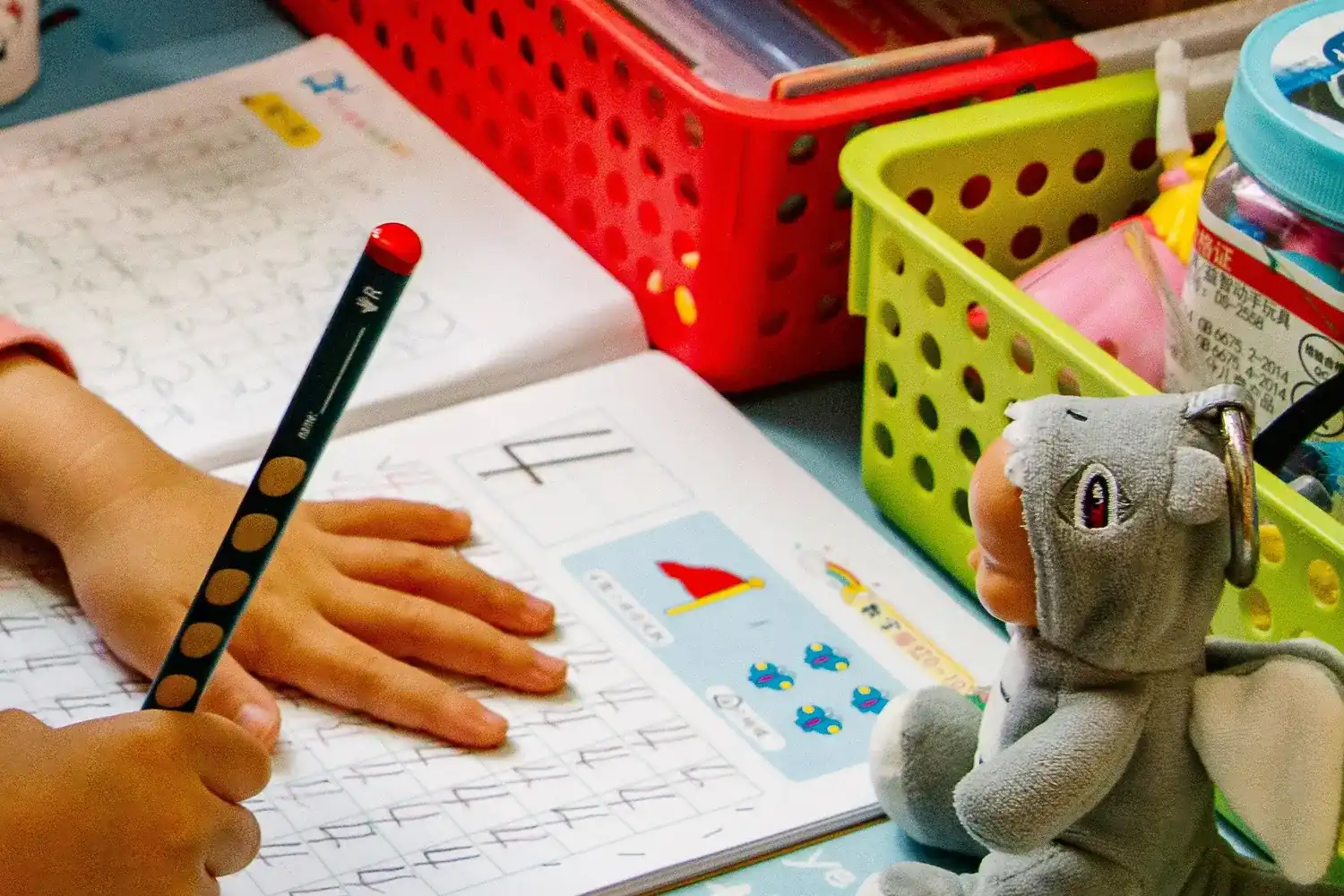
Writing carries a lot of weight in the result. The Pre-2 writing task asks for an opinion plus two reasons in response to a prompt.
For elementary students, the wall often shows up before English even enters the picture: they cannot come up with an opinion in Japanese either. Asked Do you think children should use smartphones?, a child may simply freeze, unable to decide which side they are on.
Trying to fix the English grammar at this stage does not move things forward much. It works far better, for this age group, to decide a position in Japanese first, come up with two reasons, and only then turn that into simple English.
Three foundations worth checking before starting Pre-2 prep
Before diving into full preparation, check whether these three are actually in place. EIKEN’s own Pre-2 Can-do list describes the target the same way: reading, listening, speaking and writing about everyday topics with basic vocabulary.
- Grade 3 grammar is solid. If past tense, comparatives, infinitives, gerunds, the passive and the present perfect are still shaky going into Pre-2, a child tends to read long passages on vague feeling rather than structure. The present perfect and passive are especially easy to misread, so check whether she can translate them correctly inside a sentence, not just recognise the form.
- She can read a short sentence unaided. What matters is not whether she can solve a long passage, but whether, reading a short sentence aloud, she gets stuck word by word or can find the subject and verb. Look for whether she keeps reading through an unfamiliar word rather than abandoning the whole sentence.
- She can answer briefly in English. The interview rewards responding to what was asked, not long fluent English. Asked What do you like to do after school?, answering I like to play tennis. Because it is fun. is a perfectly good first step.
What Pre-2 looks like now
Pre-2 changed format from the first session of fiscal 2024 under the format renewal: writing now has two tasks, an e-mail reply added to the opinion essay. The Pre-2 test content page gives 80 minutes for reading and writing combined. Older workbooks and past papers may not match, so check against papers from fiscal 2024 onward. The renewal cut the written section from 37 to 29 questions and extended the first stage from 75 to 80 minutes. Word-count targets and scoring details should be checked on the official pages; this article states only what could be confirmed there.
| Skill | Content (as confirmed on the official page) | Check at home |
|---|---|---|
| Reading | 29 questions: sentence vocabulary 15, conversation blanks 5, passage blanks 2, passage comprehension 7; 80 minutes with writing | Can they read short sentences aloud and find subject and verb? |
| Writing | One e-mail reply and one opinion essay | Can they state an opinion and reasons in Japanese? Can they answer the e-mail's questions? |
| Listening | 30 questions (conversation responses, conversation comprehension and passage comprehension, 10 each); about 25 minutes | Can they explain a short conversation in Japanese? |
| Interview | Second stage after passing the first; about 6 minutes, with reading aloud a passage of about 50 words, then questions on illustrations and on the candidate's own views | Can they answer briefly when asked? |
Correct answers do not map directly onto passing
After a past paper it is tempting to ask how many correct answers pass. EIKEN decides results with the CSE score, calculated from correct answers per skill. The Pre-2 passing scores are 1322 for the first stage and 406 for the second.
EIKEN itself notes that the same number of correct answers can give different scores in different sessions, so “32 correct” on a past paper is not a fixed pass line. Balance across skills matters too: one very weak skill is hard to make up elsewhere.
At home, track the proportion correct per skill and how the types of mistakes change instead of the total. Did vocabulary improve between the first and second attempt? Did the second half of the passage fall apart less often?
The passing scores above were on EIKEN’s official pages when this article was checked (October 2026). Confirm the latest figures before the exam.
What actually works at home
For an elementary student, twenty to thirty minutes every day sticks better (for both vocabulary and sound) than two hours crammed into a weekend.
Learn words with a short example sentence attached
Staring at a word list is not enough on its own. Add three steps: listen to the audio, say it out loud, use it in a short sentence. Learning agree should mean being able to say I agree with this idea., not just recognising the word, and that habit carries straight through to writing and the interview.
Full translation is not the goal for long passages
Pushing for a perfect word-by-word translation from the start tends to make a child dislike reading English altogether. To begin with, these three things are enough:
- What is this passage generally about?
- Who did what?
- Does the writer think it is a good thing or a bad thing?
A common past-paper mistake to watch for
The single most common mistake in Pre-2 prep is running past papers too early and too often. A past paper is useful for getting used to the real format, but it is more valuable as a diagnostic tool for identifying today’s weak point.
When a score comes back low, there is always a reason: an unknown word, a grammar point, running out of time. Simply reporting “you got 40 this time” leaves a child with nothing but the memory of failing. Naming a specific win instead, such as “you got every vocabulary question in section 1” or “you stayed focused through the first passage”, and then picking one concrete thing to improve works much better.
Sorting each missed question as “did not know the word”, “knew it but missed it in context”, “ran out of time” or “careless”, and dating the note, shows what changed on the next attempt. Planning, checking and reviewing one’s own learning is the habit that the Education Endowment Foundation’s evidence summary describes as promising across subjects.
Start interview practice earlier than feels necessary
Many families plan to start interview practice only after passing the written test, but for an elementary student we strongly recommend starting earlier. It is not only about English ability: getting comfortable with the nervousness of speaking English to an adult examiner takes its own time.
Getting used to the rhythm of listening to a question, thinking briefly and answering in a short sentence matters more than building a perfect sentence. For children who can read English fine but freeze the moment they have to speak, we often start with a simple drill: respond with one short line within two seconds of hearing the question.
When to bring in a tutor or cram school
Plenty of children do reach Pre-2 on home study alone: typically ones whose Grade 3 grammar is stable, who can manage vocabulary independently, and who do not mind reviewing their own mistakes.
That said, a few signs suggest it may be worth considering outside support.
- The score is not moving despite steady vocabulary work
- She tires quickly whenever a long passage comes up
- Every piece of writing comes out sounding the same
- She goes quiet the moment interview practice starts
- Studying together as a family keeps turning into an argument
That last one is genuinely common. Parents worry because they are parents, and children push back because it is their parent asking. Bringing in a third party often makes it easier to separate what is already working from what still needs fixing, without the emotional charge.
Related EIKEN articles and tutors
If writing stalls, see why EIKEN writing stalls; if words do not stick, why memorising words is not enough; after a low past-paper score, what to fix first. Close to the exam, see the week before the first stage and the 3-day interview plan. Tutors who support EIKEN include Hannah, Haruka and Nikko; see also the Pre-2 page and EIKEN support.
How Petra Tutors approaches Pre-2 for elementary students
We start by mapping exactly where a student stands (not just vocabulary count, but gaps in grammar, what is causing trouble in listening, and how readily she can form an opinion) and suggest a study order based on that whole picture.
A confident child might move on to past papers and writing fairly early; a more cautious one may build small wins through reading aloud and short writing tasks before moving to full-format practice.
School homework, other activities, attention span and personality all factor into building a realistic plan your child can actually sustain.
In short
Pre-2 is not an easy wall for an elementary school student, but it is not an unreasonable goal either, as long as preparation follows the right order. Once you know exactly where she is stopping, the next step becomes clear. There is no need to panic over one score. Build the foundations at her own pace.
References
- Society for Testing English Proficiency | 2024 format renewal
- Society for Testing English Proficiency | Grade Pre-2 test content
- Society for Testing English Proficiency | About the EIKEN CSE score
- Society for Testing English Proficiency | CSE scores and admissions
- Society for Testing English Proficiency | Grade Pre-2 Can-do list
- Education Endowment Foundation | Metacognition and self-regulation